
Well, I did not become a crack climber overnight. I was very keen to try, believe me. Tony picked a route called The Naked and The Dead, which wasn't actually a real Indian Creek crack, but a little varied corner. I could not get off the ground. Tony claimed that technically I seemed to be doing everything right, but I had a splitting pain in my feet, when I tried to step up. I first thought that I had injured my toes in the Narrows trip (I had a little incident involving a small rockslide), and actually, when I took my shoes off, I could find the sore spot by poking. It didn't hinder my walking, and I had a nagging feeling, that it would be something more complicated than just an incidental injury.
The next day we decided to first do some touristing in the Canyonlands, and climb the afternoon. This time Tony picked a 5.9 wide twin crack, called The Twin Crack, and I started going. It felt better. My feet felt definitely a lot better in the wide crack, although this crack meandered quite a lot, and almost provided steps at times. But the wide crack was not OK for my hands... The relatively narrow start was good. I got half way up, and the crack opened more. I just couldn't find a position, where my hands would stick. Bugger. Anyway, it was promising, and I thought, well, let's try something narrow again.
Tony did something interesting looking on top-rope - courtesy of our neighbor climbers, there were queues forming here and there - and we continued after that to our next target. It was again 5.9, but looked fierce. And it was, judging by the way Tony had to fight to top off. But the start looked inviting, so I took position and was ready to go. Knee down left, foot in crack, twist knee back up.
Again, a bone splitting, teeth rattling pain in my foot. I could have cried for frustration. I knew I had it right, but still somehow, I didn't. It was getting dark, and we had to give up. Tony noted a few times about me being incredibly silent in the car on our way back. I felt cheated. Others could do it, without tears running down their faces, why couldn't I?
After an overnight sleep, I have come up with a few ideas to try, when I get the next opportunity to try cracks. Let's see, if they are the correct ideas.
Showing posts with label Indian Creek. Show all posts
Showing posts with label Indian Creek. Show all posts
Sunday, 21 October 2007

Tuesday, 9 October 2007
Last Day in the Creek
The day started wet. Frustratingly, it didn't seem so wet to abandon hope of climbing but it was too wet to actually climb. We decided to look at some of the less popular crags and were set to spend the day, in Tom's words, "like the Foreign Legion - carrying around heavy packs without actually doing anything". To get to the unpopular buttresses isn't easy. The paths are poorly defined and the terrain quite challenging. We first went to the Sabatical wall. I was overwhelmed because I had only really heard about a couple of Buttresses and suddenly there was 30 or more Indian Creeks all in a row. As I saw these close to it became apparant that for a lot of them the rock quality was quite poor and that there were considerably fewer possible lines and even fewer that I'd actually like to do. That being said there were some absolute gems there. Sabatical Wall was unsurprisingly wet, we didn't want to wait for it to dry so we went to Critic's Choice. This is home to "Belly full of Bad Berries" which is a hard wide crack that is well known after featuring in the film Return2Sender.

Belly full of Bad Berries follows the crazily steep arch shown in the picture. It starts off fingers and finished off width. In the film they make improbable moves. They seemed to spend as much time upsidedown pulling on their feet as the right way up. It was great to see but I know I'll never try it.
Getting to the base of the route was really hard. It was interesting because we had to cross strange improbable formations of sand, loose rock and mud. I've shown some images below. The approach was eerie and seemed otherworldly. It was also moderately scary as stable was one word that I would be reluctant to associate with the terrain.

I didn't go very close to this. I have no idea how it has survived or if it will be there tomorrow.
 We had to detour around formations like this. How can you possibly ascend them. Apart from destroying something beautiful I think on a practical note it would be virtually impossibe.
We actually climbed one route (Bunny Slope). It was 5.9+ and after a sandy start followed a perfect handcrack up a slab. The route was over 50m and after the first 7m was all yellow camolots. Luckily we had a small arsenal. It was a joy to climb after the wider stuff on Blue Gramma. Nevertheless, I was struggling to keep up with the pace and decided that it was time for a change of scenery. Las Vegas was calling and I was hearing its call.
more Indian Creek action
I had now spent longer at Indian Creek than I had intended, but was reluctant to leave as the climbing and the company was so good. I headed out with Kevin and climbed a couple of routes on the smaller Blue Gramma cliff. This seemed a little different from what I had done previously, as things were either a little wider or a little narrower. We had met (Jim Donini) a veteran of Indian Creek climbing the night before. He had explained that the grades at the creek were a little meaningless and could be seperated into more logical demarkations such as "anatomically incorrect". A good example of this can be seen at http://www.bigupproductions.com/bigUpSite2/parallelojams2.html
I haven't been climbing finger stacks or ringlocks, but the person who sends (climbs) this is the one whose fingers best fit the crack. As the cracks in Indian Creek are often the same size for their entire duration, what matters most is if it is a good size for you. If the crack works for you, it'll seem easy, if it doesn't it'll be a struggle. For this reason the grades are only crudely defined. I've been climbing 5.10. Usually this is subdivided into a,b,c and d. But here most of the routes have just been plain 5.10. On Blue Gramma we were planning to climb some of the wider stuff. I have small, delicate, girlish hands and the wide stuff was going to be a challenge.
 Blue Gramma cliffs
 Gearing up for some wider stuff. Not a yellow camalot in sight. For me yellow is "perfect hands", red is "tight hands". I can climb reds where some struggle (e.g. Kevin - I hope you don't mind). Although I loved Supercrack that was tight blues and for me nice "cupped hands". I'm gearing up for a wider blue crack which I found to be shakey "cupped hands" but too tight for "fists". Kevin cruised this, I like to think because he has larger hands, Toby would have loved every moment of it. I was unsteady but managed to complete the Unnamed route 5.10.
 Kevin at the base of two routes. We climbed both Dawn of an Age 5.10b (left) and the unnamed (right). Dawn of an Age was problematic as the crack became awkwardly wide and you had to layback on rounded edges. Laybacking is a funny buisness because when you do it, it's virtually impossible to place gear. You also have to layback quickly as it's strenous. It's also more demanding in Indian Creek (compared with Finland or Norway) because the friction for the feet is worse meaning that more force is necessary on your arms. This is also my least favourite, elbow-injury inducing move. Also when you're laybacking the most challenging thing is to stop laybacking (this is invariably done above your protection as it's almost impossible to place whilst laybacking). Anyway for me this was the crux of the route, and it was with relief that the angle eased, and I could get the weight onto my feet to place a cam.
We then climbed a fantastic unnamed 5.10. The guide book description read "tight hands to off width". The guide book description didn't lie. I thrashed my way up, but it was a really good summary of almost everything that was Indian Creek. I placed every camalot from number 1 to number 6. The photo shows Kevin in front of the crack (which is tight #1s at this stage). He's holding a #6 which shows how wide the crack got. I was pretty solid from sizes 1 until 4, then things got really hard and Kevin had to hold me on the rope several times as I puzzled the, what then seemed intractable, wide wide moves. Eventually I topped, with all the style of a sumo wrestler performing ballet. I had bled over the route and Kevin's larger cams. I felt truely beaten up, but I was laughing as I lowered down. I doubt I'll ever place all the camalots from 1 to 6 on a single pitch again (not least because I don't own a #5 or a #6).
 Kevin not seeming to mind his bloody big cam. I refer to the presence of my blood on the hardware, but bloody as a adjectivoral modifier works just as well.
Saturday, 6 October 2007
The Friends of Indian Creek
Indian Creek is unique amongst American climbing Destinations. Most of the famous ones lie in National or State Parks and are subject to camping restrictions, park fees, and are managed by Rangers. Climbers are generally a good crowd and whilst they form a more anarchic group than participants in other sports are likely to do, every climber feels a stewardship towards the land on which they climb. In Indian Creek the camping is as wild as wild gets. There are no amenities and no drinking water. This makes the Creek not only a fantastic climbing venue but also a beautiful camping spot, where you can co-exist with unspoilt nature. This situation can’t be taken for granted, and in a country where land access is a privilege or exception rather than a right. The climbing community has formed a unique agreement with the land agency whereby they manage themselves. This is to everyone’s benefit; it means that climbers get the unspoilt environment that they so crave and the land agency gets the issues which they consider pertinent addressed. The main concern is human waste, and has been solved by the distribution of “wagbags”. These are basically bags into which you can defecate. The whole process, whilst sounding unsavoury, isn’t actually too unpleasant. This is helped by the presence of toilet paper, an antibacterial handwipe and a lavender scented water absorbent silica in the bottom of the wagbag. Although I could conceive wagbag mishaps, for example falling backwards into it, or urinating in one’s shoes, I found the whole process relatively straight forward and I’ve avoided any accidents.
 The pristine camping
 The wagbag. Restop 1 is for number ones.
 The hightech insides.
 The pristine camping
 The wagbag. Restop 1 is for number ones.
 The hightech insides.
Day 8
There is a huge wealth of climbs in Indian Creek and I’d realised that it was important to play to my strengths. I’m better suited to endurance climbs than steep test pieces. I also prefer the splitter style cracks to the corner cracks. My mind kept coming back to Generic Crack that we had done on the first day. I’d got it clean despite it’s length and my newness to Indian Creek climbing. Also, I was the only person in our group who could either do it, or liked it. The bottom part of the crack was flared and I think that this phased some people. To me it wasn’t a problem as I had spent a large amount of last year working on a flared crack project in Haukkakallio . On lead I felt the same as I did on Supercrack, I didn’t plan the gear well and brought too few #2 camalots and too many larger ones. This meant that I had to run things out a little further above the pieces I did have, but even then I felt in control in a similar way to Supercrack. I felt good and confident again but exhausted, particularly by the unrelentless heat of the desert. I then climbed Binou’s Crack 5.9. This was a bit different from where my strengths are but I felt fine the whole way. It involved a bit of laybacking, and the top part of the climb was protected entirely by Aliens. Aliens are small cams, and with their counterparts from other manufacturers they have revolutionised the climbing of thin cracks, providing protection where previously none was available. Small camming devices are not as good as the larger ones and whilst people do fall on them even on soft sandstone I don’t trust them in the manner that I trust the larger pieces. Despite this I stayed calm and in control. At this stage dark clouds provided some relief from the sun but the wind picked up and rain looked imminent. Despite just having done two routes, we decided to call it a day. Calling it a day wasn't a bad idea, the weather turned windy and blew dust into the tents, I don't know whether it counts as a dust storm, but the combination of dust and wind was enough to convince a Northern European not to climb.
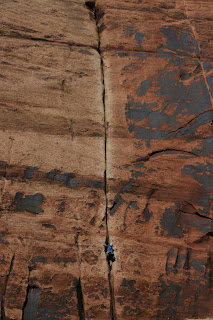 A random punter on Generic crack. Actually, I told the belayer the URL of this site and offered to email photos if they got in contact. So if you want them, you can have them.
 A random punter on Generic crack. Actually, I told the belayer the URL of this site and offered to email photos if they got in contact. So if you want them, you can have them.
Day 7
The previous day had been a rest day and was spent at the Internet Café, gear shop and supermarket. I went back to Supercrack Buttress with Dennis, Tom and Kevin who were all on the Splitter Camp. I was fired up to do Supercrack, it had been the picture which had inspired me to cross the Atlantic, it had felt solid on top rope, and there was no excuse not to climb it. The initial section felt awkward, the layback more complex, and the contorted position from which the crucial cam can be placed seemed more unsteady. Regardless, I was soon standing on the rock pedestal staring up at the apparently endless crack cleaving the face in two. One thing to note about Indian Creek cracks is not to look up. The higher you climb the further away the ground looks and, whilst it might not sound intuitive, this is quite relieving. When you look up, the top of the route looks exactly the same distance as when you were standing on terra firma relaxed. I couldn’t resist looking up, I wanted to see the crack in all its perfect glory. Every jam with either hands or feet felt secure. I had complete faith in the gear that I was placing (yellow camalots to the roof, blue camalots above). I fell into a routine – place gear at chest height, climb until the gear was below my feet, make two more moves, place gear at chest height. With this routine I felt confident and started to count 4 and then 6 moves after my feet had passed the gear before I placed the next piece. This felt completely safe as I had absolute trust in every cup of my hands and twist of my feet, and unless I ran out of steam I couldn’t see how I could possibly fall off. On reaching the anchor the adrenaline of the climbing was replaced by a wave of lactic acid. I clipped myself to it and fell exhausted on the rope, with the satisfaction of a job well done. I’d climbed the line that I had stared at in magazines, and dreamed of climbing; it had also, dare I say it, felt fairly easy. When I got to the ground the joy remained but I was enveloped in a feeling of tiredness. I’d climbed the route in Indian Creek that I had most wanted to, I’d done it in a style which I was proud of, and I’d proved to myself that I was able to repeat what I’d learned when it really counted. Supercrack deserves its name and more, WorthcrossingtheAtlanticforcrack would be an equally fitting name.
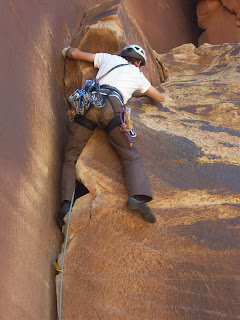 The bouldery awkward start to Supercrack
 Passing the small roof.
 You feel all alone as you climb the perfect crack,there isn't a hold in sight.
Without resting properly and with overconfidence that I was a 5.10 climber I jumped on to The Incredible Handcrack too soon. I’m not sure what convinced me that I could climb this, I’d only just scraped through on top rope and I knew that I was suited to the long endurance climbs like Supercrack but not the overhanging lines like Incredible. Initially it went well and I had climbed the overhanging section and had my feet a metre past the last cam. I was on the crux, climbing overhanging cracks is hard but the hardest part is the transition from overhang back to the vertical. Again my feet popped and this time my hands couldn’t hold me. I fell but thanks to Dennis’s excellent belaying not far. I lowered to the ground, rested more and then went for it, I managed to pull through the crux, but whereas every point of contact with the rock had felt secure in Supercrack, in Incredible I felt like I was adhering to the rock by a delicate combination of sufficient friction and luck. The top eases off and despite there being many points which one can rest the calmness and composure that had been there on Supercrack was replaced with uncertainty yet determination.
I knew that Incredible had been an ambitious plan and after resting I thought that I should try something else, something new. This saw me at the bottom of 3 a.m. crack. 5.10. It was more of the same but a little more varied (tight hands, into perfect hands, into wide hands). The confidence that I’d had on Supercrack wasn’t there. I felt I put in a good effort but had to rest on the rope twice. At the end I was shattered, on top of the physical strains of crack climbing I’d found the merciless sun delapitating. It was time to call it a day, collect my thoughts and re-evaluate my targets.
 Tom climbing 3 a.m. in better style than myself.
 The bouldery awkward start to Supercrack
 Passing the small roof.
 You feel all alone as you climb the perfect crack,there isn't a hold in sight.
Without resting properly and with overconfidence that I was a 5.10 climber I jumped on to The Incredible Handcrack too soon. I’m not sure what convinced me that I could climb this, I’d only just scraped through on top rope and I knew that I was suited to the long endurance climbs like Supercrack but not the overhanging lines like Incredible. Initially it went well and I had climbed the overhanging section and had my feet a metre past the last cam. I was on the crux, climbing overhanging cracks is hard but the hardest part is the transition from overhang back to the vertical. Again my feet popped and this time my hands couldn’t hold me. I fell but thanks to Dennis’s excellent belaying not far. I lowered to the ground, rested more and then went for it, I managed to pull through the crux, but whereas every point of contact with the rock had felt secure in Supercrack, in Incredible I felt like I was adhering to the rock by a delicate combination of sufficient friction and luck. The top eases off and despite there being many points which one can rest the calmness and composure that had been there on Supercrack was replaced with uncertainty yet determination.
I knew that Incredible had been an ambitious plan and after resting I thought that I should try something else, something new. This saw me at the bottom of 3 a.m. crack. 5.10. It was more of the same but a little more varied (tight hands, into perfect hands, into wide hands). The confidence that I’d had on Supercrack wasn’t there. I felt I put in a good effort but had to rest on the rope twice. At the end I was shattered, on top of the physical strains of crack climbing I’d found the merciless sun delapitating. It was time to call it a day, collect my thoughts and re-evaluate my targets.
 Tom climbing 3 a.m. in better style than myself.
Splitter Camp - Day 3
This was the final day of Splitter Camp, I was battered, bruised and exhausted. Despite this I felt a surge of energy when it was announced that we would be at Supercrack Buttress. Supercrack Buttress is so named as it is the site of the infamous Supercrack (also known as Supercrack of the Desert and previously known as Luxury Liner). Supercrack Buttress is also home to The Incredible Handcrack . You may be thinking that the Buttress is also home to inflated naming, but I didn’t – I’d seen pictures and I believed these would live up to their names.
So I founded my cut, tired and scraped self at the bottom of Incredible Handcrack. I only just managed it on top rope. The crack itself is perfect but I definitely have problems when the terrain becomes overhanging. At one stage my foot popped out of the crack and I was left hanging on my hands which were jammed into the crack. This shockloaded my elbows and caused some discomfort. I then declined any further top ropes as there were rumours of Supercrack being put up.
 Dennis on The Incredible Handcrack
This didn’t quite go as I’d intended it as I climbed Twin Cracks (5.9) because they looked easy and non-strenuous. Then some rain started to come in (yes in the desert) and as I thought the chance to climb Supercrack was about to pass, Dave offered to put it up as a top rope. I then got the chance to climb Supercrack in the drizzle. The crux is getting into the crack and requires some awkward layback moves. The crack itself is perfect hands up to and through a small roof, after this it becomes cupped hands and goes on and on in some kind of wide hand endurance test. As the crack becomes wider the feet become better and I got into a rhythm and found myself running up the crack, the feet are so solid that it is really easy to rest and I was amazed at how easy I had found the climbing. Of course I was tired when I reached the anchor chains but I wasn’t exhausted and this I found really encouraging. As all climbers know climbing these routes on a top rope is one thing but climbing on the sharp end, when you have to hang around and place gear, is a different matter altogether. As the rain came in and we moved back to the vehicles I considered how I would do when I came to lead these routes. The Splitter Camp was great in practising the techniques required, but until I started to lead some of these routes the jury was out with regards to my performance.
Todays routes
The Incredible Handcrack 5.10c (only just)
Twin Cracks 5.9
Supercrack 5.10
Wednesday, 3 October 2007
Splitter Camp Day Two
The day started with a couple of laybacking routes. I think that the problems I’ve had with my elbow are related to laybacking so I took these pretty easily. The first was no problem but the second proved to be more of a challenge. We then climbed the Jolly Rancher, 5.10, a fantastic endurance splitter which required tying two ropes together to top rope. It was varied and epitomised what Indian Creek climbing was all about. We had to concentrate on everything we had previously been told and combine almost all of the techniques as the crack varied from a size where we could barely squeeze our hands in to one where they felt loose within the crack. Two of us (Dennis and I) flashed this and Dave Medara (the instructor) seemed pretty impressed and decided that it was time to put us on something hard - the wildly overhanging route of Spagetti Western (5.11+). The list of routes Short and stupid 5.9 Skidmarks 5.10 Jolly Rancher 5.10 Spagetti Western 5.11+ (1 fall, three rests) Pinjon Pining first pitch 5.7 Chambered Round 5.10

 Nearing a quarter way of up Jolly Rancher
 The unbelievably challenging Spagetti Western. I actually climbed all that is visible in the photo with only one fall. However, I was so completely spent that I needed three rests to complete the route. This is Dennis not me in the photo.

Concentrating on the footwork necessary to climb sustained cracks
 Nearing a quarter way of up Jolly Rancher
 The unbelievably challenging Spagetti Western. I actually climbed all that is visible in the photo with only one fall. However, I was so completely spent that I needed three rests to complete the route. This is Dennis not me in the photo.
Splitter Camp - Day one
I’ve read a lot about the cracks in Indian Creek canyon. The more that I’d read the more I’d wanted to climb them. The more that I’d read the more that I’d scare myself that I couldn’t. Desert climbing starts at 5.10. There are a few easier routes but they are the exceptions. The climbing generally follows immaculate cracks which bisect the cliffs. It’s an area where style is king. If you’ve got it you’ll fly if you haven’t you’ll flail. I’ve climbed a lot of cracks in Finland but they’re different. They are short, they are featured and the granite has a lot of friction. In the Creek, they are long endurance tests, you have to jam as there are virtually no other options. It’s a place where hotshot Europeans can get torn apart and blown off even the easiest routes. I was afraid. In order to learn the techniques I signed up for a three day crack climbing workshop. This was run by Moab Desert Adventures (see http://moabdesertadventures.com/splittercamps.html )
 Before anything else you have to tape your hands up. The climbing is essentially on cracks resembling sandpaper and if you want some skin left on your hands, then tape is a must. Dave Medara and Greg Child demonstrate two types of wraps. The democratic low cardbon emmision reusable wrap (almost a clone of Toby's) and the superior Republican single-use high wastage wrap.
So here I was on the first morning taped up and standing at the bottom of a route. The food and the company in the evening had been excellent, but now it was time to start climbing. The principle is that we learn by doing, the guides set up top ropes and we spend a lot of time on the rope learning the techniques. After Dave Medara had lead the first route (Elephant Man 5.10) I seconded it pretty competently. But it was quite featured and followed a flake and perhaps was a little atypical of Indian Creek. Meanwhile, Greg Child had set up a top rope on Chocolate Corner 5.9. This follows a perfectly parallel crack in a corner flanked by near featureless walls. This is how I imagined the Creek, this would be the test. First hand in, perfect, first foot in – twist the foot, perfect, now step up and place the next hand, perfect, OK now get the second foot, perfect. The jams stuck to the cracks like glue. Repeat - perfect, repeat - perfect, repeat - perfect “Oh my God, this is so good”, I call. Repeat -perfect, repeat - perfect “This is unbelievable” repeat - perfect, repeat - perfect and then the top comes all too soon. I’d just climbed the most immaculate crack that I’d seen. Every jam was bomber and I was on a high. This route was worth crossing the Atlantic for. What’s more (albeit on a top rope) I’d felt really solid on it. My fears of struggling with the climbing here drained away and were replaced with confidence.
 Marlene on the tight hands Chocolate Corner
 Dave Medara leads the sensational and unique Mr. Peanut
 Before anything else you have to tape your hands up. The climbing is essentially on cracks resembling sandpaper and if you want some skin left on your hands, then tape is a must. Dave Medara and Greg Child demonstrate two types of wraps. The democratic low cardbon emmision reusable wrap (almost a clone of Toby's) and the superior Republican single-use high wastage wrap.
So here I was on the first morning taped up and standing at the bottom of a route. The food and the company in the evening had been excellent, but now it was time to start climbing. The principle is that we learn by doing, the guides set up top ropes and we spend a lot of time on the rope learning the techniques. After Dave Medara had lead the first route (Elephant Man 5.10) I seconded it pretty competently. But it was quite featured and followed a flake and perhaps was a little atypical of Indian Creek. Meanwhile, Greg Child had set up a top rope on Chocolate Corner 5.9. This follows a perfectly parallel crack in a corner flanked by near featureless walls. This is how I imagined the Creek, this would be the test. First hand in, perfect, first foot in – twist the foot, perfect, now step up and place the next hand, perfect, OK now get the second foot, perfect. The jams stuck to the cracks like glue. Repeat - perfect, repeat - perfect, repeat - perfect “Oh my God, this is so good”, I call. Repeat -perfect, repeat - perfect “This is unbelievable” repeat - perfect, repeat - perfect and then the top comes all too soon. I’d just climbed the most immaculate crack that I’d seen. Every jam was bomber and I was on a high. This route was worth crossing the Atlantic for. What’s more (albeit on a top rope) I’d felt really solid on it. My fears of struggling with the climbing here drained away and were replaced with confidence.
 Marlene on the tight hands Chocolate Corner
We then cranked things up a little with by top roping a much harder route. I felt shaky but climbed it clean nevertheless. The crux involved a long layback off a finger crack which swallowed my fingers with the feet heel-toe jammed in an off-width crack. Somehow, these movements worked. I managed the top with wild bridging with my left foot smearing against the thin crack and my right knee bared in the off-width which now resembled a flared chimney corner. For non-climbers, this involved whacky improbable moves which actually felt pretty good .
 Dave Medara leads the sensational and unique Mr. Peanut
That day I climbed (all on top rope)
Elephant Man (pitch 1) 5.10
Chocolate Corner 5.9
Mr Peanut 5.11 (twice because it was so fun)
Unnamed crack number 17 5.9
Generic Crack 5.10-
The Naked and the Dead 5.8
The Naked and the Dead Variation 5.11 (with three falls)
Elephant Man (pitch 1) 5.10
Chocolate Corner 5.9
Mr Peanut 5.11 (twice because it was so fun)
Unnamed crack number 17 5.9
Generic Crack 5.10-
The Naked and the Dead 5.8
The Naked and the Dead Variation 5.11 (with three falls)
Subscribe to:
Posts (Atom)